Anti-Semitism
An Officer and a SpyAnti-Semitism is shown as a system of assumptions that makes Alfred Dreyfus seem guilty before his conduct or the evidence against him can be fairly assessed. It appears in public chants, military judgments, and private conversation: Jewish identity is treated as proof of deficient patriotism, concealed allegiance, and suspicious wealth. The narrative’s force comes partly from showing how these claims travel between settings, until prejudice no longer sounds like an assumption but like a reason for conviction.
Public Hostility and the Degradation Ceremony
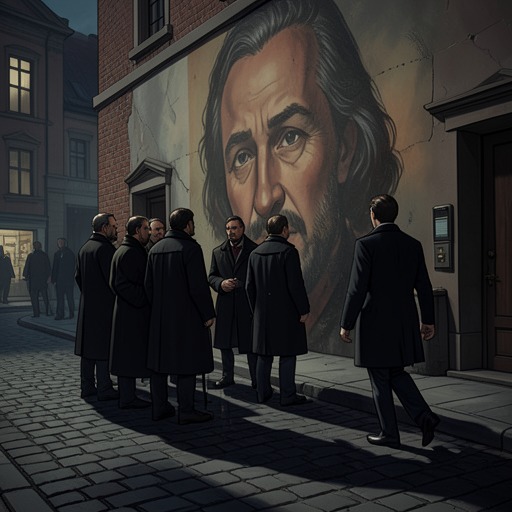
At Dreyfus’s degradation ceremony, the crowd’s repeated chant of death turns hostility into a public spectacle. The ritual has an official military purpose, but the spectators’ abuse gives it a further meaning: the condemned man is attacked not only as a supposed traitor but as a Jew. During his escorted march, Dreyfus repeatedly declares his innocence, while spectators answer with accusations of treachery and antisemitic slurs. His defense is audible, but it does not interrupt the crowd’s certainty.
The response of the officers watching makes the imbalance more explicit. A Foreign Ministry official treats Dreyfus’s submission to humiliation as evidence against him, reasoning that an innocent man would resist. He then recasts that very submission as a supposed Jewish characteristic. Jean Sandherr endorses the prejudice and expands it into a sweeping claim that Jews lack patriotism, honor, and pride, invoking centuries of alleged betrayal. The reasoning is self-sealing: resistance could be read as defiance, while endurance is made into proof of an allegedly racial disposition. Dreyfus’s conduct cannot acquit him within a framework that has already assigned meaning to it.
Georges Picquart’s account of the ceremony also draws attention to the gap between the public accusation and the person being accused. While Sandherr turns away in contempt, Picquart continues watching Dreyfus pass, noticing his appearance and the strain visible in his face. The crowd’s language reduces him to a category; the narrated encounter instead registers a particular person undergoing humiliation. That contrast does not undo Picquart’s earlier judgments, but it makes the dehumanizing effect of the crowd’s certainty visible.
Prejudice in Private Conversation
The same assumptions surface at a family lunch attended by Picquart, Louis Leblois, Edmond Gast, Pauline Romazzotti, and Philippe Monnier. Most of those present are exiles from Alsace, yet even Edmond, whose politics are described as radical republican, has no good word for Dreyfus. The guests exchange stories about Jews in places such as Mulhouse, claiming that some chose German citizenship when given the choice after the war. The conversation turns particular cases into a general theory of Jewish disloyalty.
Philippe Monnier gives that theory a figurative rationale: Jews, he says, shift with whoever holds power, and that adaptability explains how the group has survived. The remark presents suspicion as almost an explanation of history, making a stereotype sound like worldly observation rather than an accusation requiring proof. The setting matters. These are not only officers issuing commands or demonstrators shouting in a crowd; prejudice is also reproduced at a table among people whose shared experience of displacement might have invited a more complicated understanding of loyalty and belonging.
Leblois is the one person at the lunch who raises a procedural objection. Speaking as a lawyer, he opposes secret trials in principle and wonders whether a Christian officer would have been denied the ordinary judicial process, particularly given the thinness of the evidence as reported in Le Figaro. Picquart answers that national security required secrecy and insists that the case contains ample evidence. The exchange exposes two different ways of treating uncertainty: Leblois asks whether Dreyfus received equal legal treatment, while Picquart defends the process and its conclusion. In this conversation, prejudice does not silence every doubt, but it sits beside the defense of secrecy and helps make that defense easier to sustain.
Suspicion Recast as Motive and Policy
In a later conversation with the ill, retired Sandherr, the subject shifts from accusations about Dreyfus to proposals concerning Jews more broadly. Sandherr describes a list of one hundred thousand aliens who would be interned if war broke out; Jews are not included in that list. He nevertheless argues that Jews should at least be required to register and face curfews and travel restrictions. The distinction does not signify acceptance. It places Jews in a separate category for proposed controls, justified through Sandherr’s wider fear that foreigners and changing moral standards have made Paris unfamiliar and the nation impure.
Picquart raises Raoul le Mouton de Boisdeffre’s concern that renewed interest in the Dreyfus case might encounter a problem of motive. Sandherr dismisses the concern by treating Jewish identity itself as an answer. He alleges that Dreyfus is more German than French, that most of his family live in Germany, and that his income came from Germany. Those claims are presented as Sandherr’s assertions, not independently established facts. Their role in the exchange is clear, however: presumed ethnic and financial ties are offered in place of a specific motive, allowing suspicion to stand where an evidentiary explanation is lacking. Sandherr also invokes the unanimous judgment of seven judges as confirmation, folding an earlier verdict back into the argument rather than reconsidering the assumptions that shaped it.
Picquart’s Prejudice and the Distribution of Credibility
The novel gives the account of these attitudes through Picquart, whose own earlier response to Dreyfus complicates his position as observer. As a professor of topography at the École Supérieure de Guerre, Picquart taught Dreyfus among roughly eighty students. He remembers Dreyfus as thin, pale, solemn, and myopic, and interprets his money, clothing, marriage, and family’s connection to Germany through a stereotype he associates with being a typical Jew. Dreyfus’s affluence and social manner become, in Picquart’s perception, signs of Jewish ostentation and ambition; the account records the prejudice operating inside the narrator’s own descriptions, not merely in the mouths of more openly bigoted characters.
When Picquart gives Dreyfus a lower mark than Dreyfus believes he deserves, Dreyfus asks directly whether his Jewishness is the reason. Picquart denies that personal prejudice has affected his judgment. Dreyfus observes that Picquart’s insistence on being scrupulous does not settle the question. The exchange leaves the denial under pressure: Picquart claims impartiality, while the language and associations through which he has described Dreyfus show how thoroughly inherited assumptions have entered his assessment. Dreyfus’s challenge is therefore more than a request for a fair grade; it identifies the possibility that a judgment presented as professional may carry an unacknowledged bias.
That inequality of credibility reaches its sharpest official form when Hubert-Joseph Henry tells the court that an informant identified a traitor in the Second Department and points to Dreyfus as that man. The accusation is attributed to an unnamed source described as honorable; Dreyfus, by contrast, is made to demand the informant’s identity after the accusation has been delivered. The scene places an unsupported assertion from within the military hierarchy against the accused officer’s protest. Read alongside the racial reasoning voiced elsewhere, it shows how institutional authority can lend weight to accusation while Dreyfus’s own word struggles to count. Anti-Semitism thus links private stereotype to public judgment: it supplies a ready-made account of disloyalty, then helps preserve that account even when the accused contests it.